Pregnancy Care Breakthroughs 2025: What’s New
Article Title
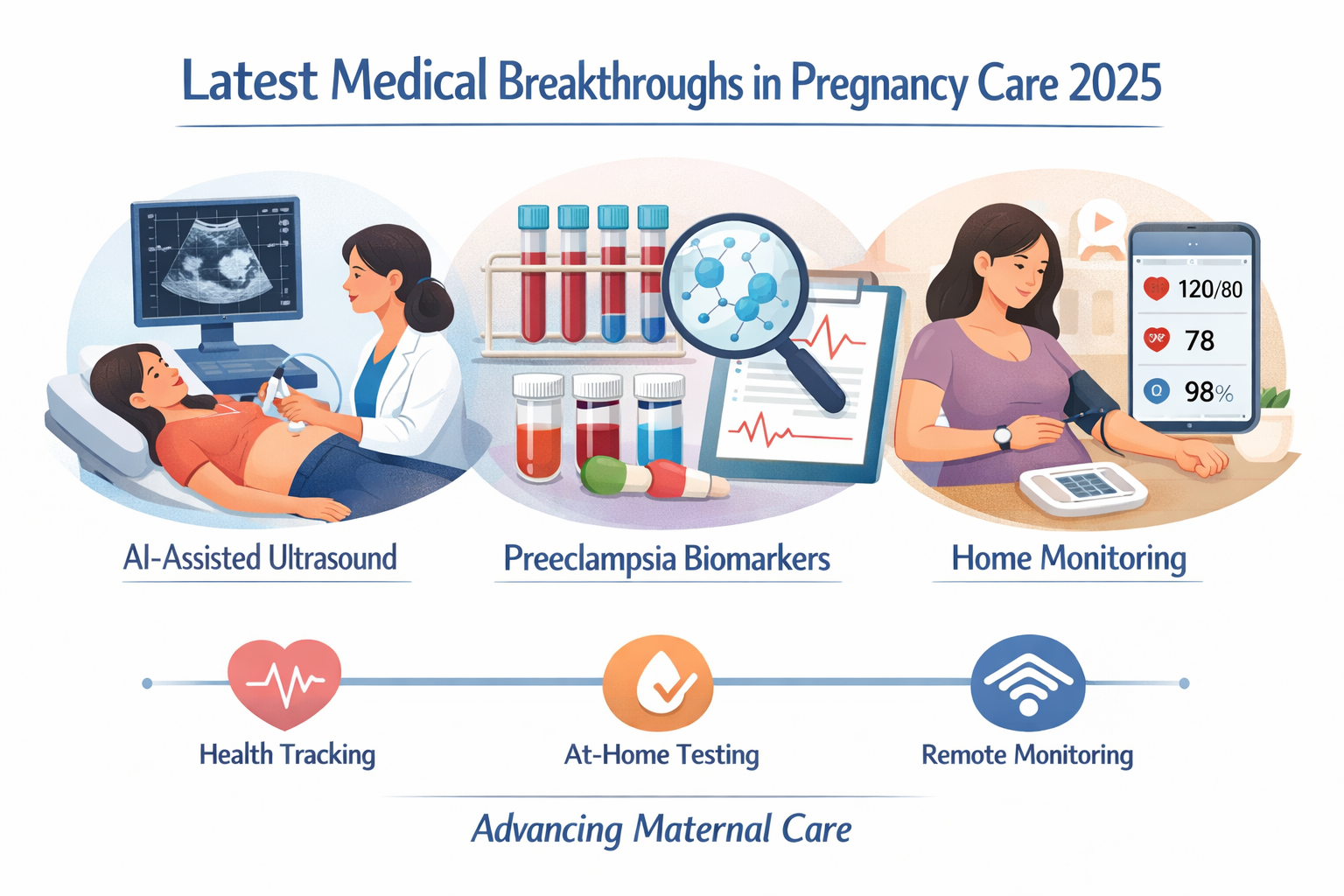
Latest Medical Breakthroughs in Pregnancy Care in 2025: From AI-Assisted Ultrasound to Preeclampsia Biomarkers and Home Monitoring
Abstract
In 2025, pregnancy care moved decisively toward precision, personalization, and real-world accessibility. ACOG’s 2025 clinical consensus emphasized redesigned prenatal care delivery—addressing unmet social needs, rethinking visit frequency, and integrating telemedicine and alternative care modalities 1. AI-assisted ultrasound crossed a key threshold from “promising” to “practical,” with the PROMETHEUS randomized trial reporting shorter scans and lower sonographer cognitive load without reduced diagnostic performance 2. For suspected preeclampsia, angiogenic biomarker testing (sFlt-1/PlGF ratio) gained stronger operational footing via clinical thresholds used to guide short-term risk triage and care pathways 4. Feasibility evidence for home maternal-fetal monitoring (home CTG and home ultrasound) also strengthened in 2025, showing clinically interpretable recordings and high acceptability in a high-risk cohort 6. In gestational diabetes, the GRACE trial found rt-CGM reduced LGA births while highlighting the need to avoid overly tight glycaemic targets that could contribute to SGA risk 7. Globally, WHO released consolidated postpartum haemorrhage guidance on 5 October 2025 and promoted rapid-response bundles such as MOTIVE 8, and also introduced a digital adaptation kit to support self-monitoring of blood pressure in pregnancy (15 July 2025) 10. This article combines an evidence-based review of these advances with a 2025 keyword-intent map reflecting how pregnant people typically search and progress from questions to decisions.
Article
Medical note This article is educational and not a substitute for professional care. Seek urgent medical attention for warning signs such as heavy bleeding, severe headache, vision changes, severe upper abdominal pain, or markedly reduced fetal movements.
1) What truly changed in 2025?
The headline shift in 2025 wasn’t just “new tech.” It was a new mindset: prenatal care as a flexible pathway, not a fixed calendar. ACOG’s 2025 consensus explicitly frames prenatal care redesign around three practical pillars: addressing unmet social needs, reconsidering visit frequency/monitoring, and incorporating telemedicine and alternative modalities 1. The result is a care model that aims to be both safer and more humane—especially when time, travel, cost, or anxiety become real barriers.
2) 2025 keyword-intent map (search chains people follow)
People rarely type one perfect query. They move in chains—from “What is this?” to “What should I do?” to “What’s safest for me?”
Cluster A — General prenatal care
- “prenatal care” ↳ “prenatal visit schedule” ↳ “pregnancy tests by trimester” ↳ “week-by-week pregnancy checklist”
- “12-week scan” ↳ “what is NT?” ↳ “what happens if NT is high?”
Cluster B — Hypertension & preeclampsia
- “high blood pressure in pregnancy” ↳ “preeclampsia symptoms” ↳ “headache + blurry vision pregnancy”
- “sFlt-1 PlGF ratio test” ↳ “what does 38 mean?” ↳ “can it rule out preeclampsia?” 4
Cluster C — Gestational diabetes
- “gestational diabetes” ↳ “targets for fasting glucose pregnancy” ↳ “CGM in pregnancy vs fingersticks” 7
Cluster D — Telemedicine & home monitoring
- “telehealth prenatal visits” ↳ “which visits can be virtual?” 1
- “home CTG monitoring” ↳ “remote fetal monitoring safety” ↳ “home ultrasound pregnancy” 6
Cluster E — Vaccines in pregnancy
- “RSV vaccine during pregnancy” ↳ “which weeks should I get it?” 13
- “Tdap pregnancy 27–36 weeks” 12
- “flu vaccine pregnancy 2025–2026” 14
- “COVID vaccine pregnancy 2025–2026” [15]
3) The major medical breakthroughs in pregnancy care (2025)
Breakthrough 1 — Tailored, hybrid prenatal care models
2025 made hybrid care feel “official,” not improvised. ACOG supports telemedicine and other visit modalities when they serve patient needs and maintain quality 1. For many low-risk pregnancies, that can mean fewer unnecessary trips. For higher-risk pregnancies, it can mean more frequent, more structured monitoring—without automatically increasing burden.
Breakthrough 2 — AI-assisted fetal anomaly ultrasound: faster scans, lower cognitive load
The PROMETHEUS randomized trial reported:
- Shorter scan time with AI assistance (median 11.4 minutes vs 19.7 minutes)
- Lower sonographer cognitive load (lower NASA-TLX)
- No reduction in diagnostic performance reported in the abstract 2.
Beyond assistance, 2025 research in npj Digital Medicine described “whole-examination” AI: extracting biometrics across entire 20-week scan videos and using Bayesian estimation to improve robustness and reduce reliance on manual frame selection, achieving human-level performance in retrospective evaluation 3.
Breakthrough 3 — Preeclampsia triage with angiogenic biomarkers (sFlt-1/PlGF)
In suspected preeclampsia, the clinical problem is often speed and uncertainty: who is likely to deteriorate soon, and who can be safely monitored as an outpatient?
Operational 2025 guidance provides pragmatic thresholds:
-
NHS Lanarkshire guidance (for suspected PET, 20–36+6 weeks, singleton) highlights:
- ≤38: very low risk of developing PET within 7 days
- >38 to ≤85: increased risk within 7 days
- >85: very high risk within 7 days 4
-
Health NZ Canterbury guidance states:
- ≤38 can rule out preeclampsia for at least one week with very high NPV (values cited in the document)
- >38 suggests placental insufficiency and higher risk trajectories 5
These tests are not “diagnosis by blood result.” They are decision-support tools that clarify short-term risk when clinical signals are mixed 4.
Breakthrough 4 — Home maternal-fetal monitoring feasibility (home CTG + home ultrasound)
A PLOS ONE feasibility study (Nov 2025) evaluated home CTG and home ultrasound in high-risk pregnancies. Key findings in the abstract included:
- Home ultrasound identification rates: heartbeat 92%, movements 83%, liquor assessment 100%
- About three-quarters of CTGs contained at least 20 minutes of continuous interpretable fetal heart-rate recording
- High adherence/acceptability; no device-related adverse maternal-fetal outcomes reported 6
It’s not “home replaces hospital.” It’s “home extends care” when appropriate.
Breakthrough 5 — rt-CGM in gestational diabetes: fewer LGA births, but avoid overtight targets
In the GRACE randomized trial (2025):
- LGA births were lower with rt-CGM (4% vs 10%)
- Serious adverse events did not differ significantly
- Authors noted an unexpectedly high overall SGA prevalence, possibly related to tight glycaemic control, calling for further research on optimal targets 7
The lesson is mature and practical: better measurement helps—if goals are set wisely.
Breakthrough 6 — New WHO postpartum haemorrhage (PPH) guidance and rapid-response bundles
WHO’s 5 October 2025 release and consolidated guideline emphasize prevention, early recognition, and rapid standardized response 8. The WHO news release highlights immediate deployment of the MOTIVE bundle once PPH is diagnosed: massage, oxytocics, tranexamic acid, IV fluids, vaginal/genital tract examination, and escalation if bleeding persists 8.
When minutes matter, a rehearsed bundle saves lives.
Breakthrough 7 — Digital support for blood-pressure self-monitoring in pregnancy (and a device reality-check)
On 15 July 2025, WHO introduced a digital adaptation kit designed to help health systems implement recommendations for self-monitoring blood pressure during pregnancy 10. At the same time, real-world implementation depends on accurate devices: a 2025 paper in Journal of Human Hypertension underscores gaps in availability of validated automated BP monitors suitable for pregnancy in retail settings [16]. Self-monitoring is powerful—when measurement is trustworthy.
Breakthrough 8 — Maternal immunization guidance remained prominent (2025–2026)
- SMFM (Sept 2025) reiterates maternal vaccination recommendations across COVID-19, influenza, and RSV in pregnancy 11.
- CDC recommends Tdap during each pregnancy, preferably at 27–36 weeks 12.
- CDC presents maternal RSV vaccination (32–36 weeks) as an option to protect infants 13.
- CDC published 2025–2026 influenza season recommendations and ACIP highlights influenza vaccination for people who are or might be pregnant during flu season 14.
- CDC’s 2025–2026 COVID-19 routine guidance describes an individual-based (shared clinical decision-making) approach [15].
4) Closing synthesis
2025’s pattern is consistent across topics: the future of pregnancy care is hybrid, data-informed, and risk-aligned—from AI-assisted imaging to biomarker triage, from home monitoring feasibility to digital self-care standards 1. The winning direction is not more noise, more apps, or more alerts. It’s better signals, clearer decisions, and care that fits real lives.
References (with links)
- ACOG — Tailored Prenatal Care Delivery for Pregnant Individuals (2025) — https://www.acog.org/clinical/clinical-guidance/clinical-consensus/articles/2025/04/tailored-prenatal-care-delivery-for-pregnant-individuals (ACOG)
- PROMETHEUS RCT (PDF Abstract) — https://fetalmedicine.org/abstracts/2025/var/pdf/abstracts/2025/06915.pdf (Fetal Medicine Foundation)
- npj Digital Medicine (2025) — Whole-examination AI fetal biometrics — https://www.nature.com/articles/s41746-024-01406-z (Nature)
- NHS Lanarkshire (2025) — sFlt/PlGF ratio guideline (PDF) — https://rightdecisions.scot.nhs.uk/media/xvumdthr/sfltplgf-ratio-in-the-management-of-suspected-pre-eclampsia.pdf
- Health NZ Canterbury/Waitaha (2025) — sFlt-1/PlGF Ratio guideline (PDF) — https://edu.cdhb.health.nz/Hospitals-Services/Health-Professionals/maternity-care-guidelines/Documents/GLM0076-sFlt-1-PlGF-Ratio.pdf
- PLOS ONE (2025) — Home CTG & home ultrasound feasibility (PDF) — https://journals.plos.org/plosone/article/file?id=10.1371/journal.pone.0336797&type=printable (PLOS)
- GRACE Trial (2025) — rt-CGM vs SMBG in gestational diabetes (PubMed) — https://pubmed.ncbi.nlm.nih.gov/41308662/ (PubMed)
- WHO News (2025-10-05) — New recommendations to end deaths from postpartum haemorrhage — https://www.who.int/news/item/05-10-2025-global-health-agencies-issue-new-recommendations-to-help-end-deaths-from-postpartum-haemorrhage (World Health Organization)
- WHO Guideline (2025-10-05) — Consolidated guidelines for postpartum haemorrhage — https://www.who.int/publications/i/item/9789240115637 (World Health Organization)
- WHO (2025-07-15) — Digital tool & DAK for self-monitoring BP in pregnancy — https://www.who.int/news/item/15-07-2025-new-digital-tool-to-support-self-monitoring-of-blood-pressure-in-pregnancy — and — https://www.who.int/publications/i/item/9789240110359 (World Health Organization)
- SMFM (2025-09-23) — Respiratory Disease Season & Maternal Immunization — https://www.smfm.org/respiratory-disease-season (smfm.org)
- CDC (2025-12-02) — Tdap Vaccination for Pregnant Women — https://www.cdc.gov/pertussis/vaccines/tdap-vaccination-during-pregnancy.html (CDC)
- CDC (2025-08-18) — Protecting infants: maternal RSV vaccination option — https://www.cdc.gov/rsv/vaccines/protect-infants.html (CDC)
- CDC (2025-11-17) — 2025–2026 Flu Season + ACIP summary pregnancy note — https://www.cdc.gov/flu/season/2025-2026.html — and — https://www.cdc.gov/flu/hcp/acip/index.html (CDC)
- CDC (2025-11-04) — 2025–2026 COVID-19 Vaccination Guidance (routine) — https://www.cdc.gov/covid/hcp/vaccine-considerations/routine-guidance.html (CDC)
- Nature / Journal of Human Hypertension (2025) — Lack of validated BP devices for pregnancy — https://www.nature.com/articles/s41440-025-02304-x (Nature)